
The Real ROI of Digital Advertising
Imagine investing ₹30,000 in digital advertising and generating 200 enquiries within a month. It sounds like a successful campaign, doesn’t it? But what happens when only five of those enquiries become paying customers? The results may not be as impressive as they first appeared.
Many businesses make the mistake of judging advertising success through clicks, impressions and website traffic. While these metrics indicate audience engagement, they don’t necessarily reflect actual business performance. The real measure of success is how much profit your advertising investment generates.
Understanding digital advertising ROI helps businesses make smarter marketing decisions, manage budgets effectively and identify campaigns that deliver genuine financial returns.
What Does ROI Mean in Digital Advertising?
Return on Investment (ROI) measures the financial value a business receives compared with the amount invested in advertising. It helps determine whether a marketing campaign is generating enough profit to justify its costs.
Before evaluating campaign performance, businesses should understand a few important metrics:
Revenue vs. clicks: Website visits and clicks indicate interest, but actual sales provide a clearer picture of business performance.
Customer Acquisition Cost (CAC): Measures the total amount spent to convert a potential customer into a paying customer.
Conversion Rate: Shows the percentage of website visitors who complete a desired action, such as purchasing a product or submitting an enquiry.
Return on Ad Spend (ROAS): Calculates the revenue generated for every rupee invested in advertising.
Customer Lifetime Value (CLV): Estimates how much revenue a customer generates throughout their relationship with your business.
Profitability: Considers the expenses involved in generating revenue to determine whether a campaign actually makes money.
The standard ROI formula is:
ROI = (Net Profit from Advertising − Advertising Cost) ÷ Advertising Cost × 100

For example, suppose a business generates ₹80,000 in net profit attributable to advertising after accounting for relevant non-advertising costs, while spending ₹20,000 on ads. Its advertising ROI would be 300%.
Digital Advertising Trends and Developments in 2026
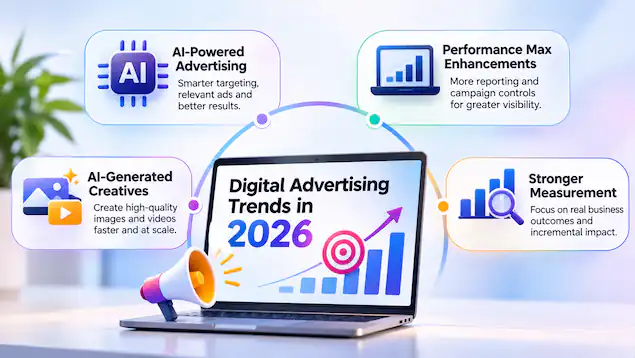
Digital advertising is changing as artificial intelligence, automation and advanced measurement tools become more widely adopted. These developments are influencing how businesses reach customers and evaluate campaign performance.
Here are some important trends shaping digital advertising in 2026.
1. AI-Powered Advertising Campaigns
Google is expanding its AI-powered advertising capabilities through features such as AI Max for Search campaigns. These tools help advertisers improve search matching, generate relevant ad text and identify suitable landing pages.
For businesses, this creates more opportunities to connect with potential customers based on their search intent. However, regularly reviewing campaign performance remains essential to avoid unnecessary spending.
2. Improved Performance Max Reporting
Google continues to improve Performance Max with additional reporting features and campaign controls. These improvements provide advertisers with greater visibility into campaign performance and help them understand how their advertising budget is being utilised.
With better reporting, businesses can make more informed decisions about campaign optimisation and budget allocation.
3. AI-Generated Advertising Creatives
Creating effective advertisements no longer requires every visual asset to be designed manually. AI-powered tools, including Google’s Nano Banana Pro and Veo capabilities, offer new ways to develop advertising images and video content.
Businesses can experiment with different creative concepts, product visuals and advertising formats while reducing some traditional production work.
4. More Attention to Advertising Measurement
Advertisers are increasingly looking beyond basic platform-reported conversions to understand the actual impact of their campaigns.
Accurate attribution and incremental measurement help businesses determine whether advertising generates additional customers and revenue rather than simply taking credit for conversions that might have happened anyway.
Key Components That Determine Digital Advertising ROI
Several factors influence whether an advertising campaign delivers a positive financial return. Understanding them helps businesses identify opportunities for improvement.
1. Audience Targeting
Reaching people who are genuinely interested in your products or services is essential. Targeting based on location, interests, search intent and customer behaviour helps reduce irrelevant traffic and improve the chances of generating qualified leads.
2. Ad Creatives and Messaging
An effective advertisement communicates its value quickly. Relevant images, persuasive headlines and clear calls-to-action help capture attention and encourage potential customers to engage with your business.
3. Landing Page Experience
Getting visitors to click an advertisement is only the beginning. Your landing page should load quickly, explain the offer clearly and provide a straightforward way to make a purchase or submit an enquiry.
4. Conversion Tracking and Analytics
Analytics tools help businesses identify which advertisements generate meaningful results. Tracking purchases, qualified enquiries and other important actions makes it easier to evaluate campaigns and decide where to invest the budget.
5. Customer Lifetime Value
A customer’s value doesn’t necessarily end with their first purchase. Repeat orders, subscriptions and ongoing relationships can generate additional revenue, making customer lifetime value an important factor when evaluating advertising performance.
Practical Ways to Improve Digital Advertising ROI in 2026
Improving advertising performance doesn’t always mean increasing your marketing budget. Making better use of available tools and data can often produce stronger results.
1. Combine AI Automation with Clear Objectives
Use AI Max and automated campaign features to improve targeting and campaign efficiency. Before activating these tools, establish clear conversion goals and review search terms, audience quality and landing page relevance.
Remember, automation works best when supported by a well-defined marketing strategy.
2. Test Multiple Advertising Creatives
Use AI-powered creative tools to produce different versions of your advertisements. Experiment with headlines, product images, short videos and promotional messages to discover what resonates with your audience.
Rather than choosing advertisements based on clicks alone, compare their conversion rates and customer acquisition costs.
3. Strengthen Your Conversion Tracking
Set up reliable tracking for purchases, phone calls, qualified enquiries and other valuable customer actions. Where possible, integrate your CRM with advertising platforms to understand which campaigns generate genuine business opportunities.
Better tracking leads to better marketing decisions.
4. Make Landing Pages More Effective
Review your landing pages to identify anything that might discourage visitors from converting. Improve mobile responsiveness, simplify enquiry forms and make important information easy to find.
Even a well-targeted advertisement can produce poor results if the landing page creates unnecessary friction.
5. Measure the Additional Business Generated
Don’t automatically assume that every conversion reported by an advertising platform is a direct result of your campaign.
Use controlled experiments, holdout groups and other measurement methods to understand whether advertising generates additional sales beyond your existing organic demand.
6. Prioritise Profitable Customer Acquisition
Compare customer acquisition costs with customer lifetime value and profit margins. A campaign may generate inexpensive leads, but that doesn’t make it successful if very few enquiries become paying customers.
Focus on attracting customers who contribute meaningful long-term value.
Real-World Examples of Digital Advertising ROI
The following illustrative examples demonstrate how businesses can improve advertising performance through practical changes.
Example 1: Local E-commerce Business
A clothing retailer invests ₹25,000 per month in social media advertising. Although the campaign attracts considerable website traffic, relatively few visitors complete purchases.
The retailer experiments with product videos, improves landing page content and provides clearer product information. These changes help more visitors make purchasing decisions, allowing the business to get greater value from its existing advertising budget.
Example 2: Digital Marketing Agency
A digital marketing agency manages Google Ads for a local service provider. The campaigns generate 100 enquiries, but many come from people outside the company’s service area.
The agency adjusts location targeting, improves conversion tracking and focuses on attracting more qualified prospects. As a result, the business can reduce irrelevant enquiries and concentrate its budget on potential customers who are more likely to convert.
Example 3: SaaS Business
A software company uses paid search campaigns to attract new subscribers. Initially, it measures success mainly through the number of sign-ups.
However, after connecting advertising data with subscription and retention information, the company discovers which campaigns attract customers who remain subscribed for longer. This allows the marketing team to prioritise campaigns that contribute more sustainable revenue.
Conclusion
The real value of digital advertising lies in the profit and business growth it generates, not simply the number of clicks or impressions. By understanding customer acquisition costs, conversion rates, customer lifetime value and campaign profitability, businesses can make more informed advertising decisions. With AI-powered tools and improved measurement capabilities shaping digital marketing in 2026, there are more opportunities to improve campaign performance. Keep testing your strategies, reviewing your results and following the latest advertising trends to make every marketing rupee count.